Inside a Thyme Essential Oil Distillation Tril: From Dried Herb to a Clean Oil Layer
Steam distillation looks simple on paper. Heat water, pass the vapour through the herb, condense it, collect the oil. Anyone who has actually run a still knows the difficulty lives somewhere else: in the thirty centimetres of glass where the condensate has to decide whether it will separate cleanly or turn into an emulsion you will spend the rest of the day chasing.
This week we ran a pilot batch of dried thyme on one of our skid-mounted distillation sets. The photographs below are from that run, not a rendering and not a stock image — which is the point. Anyone can quote a yield figure. What a buyer actually needs to see is whether the equipment produces a sharp, readable oil layer at the end of it.
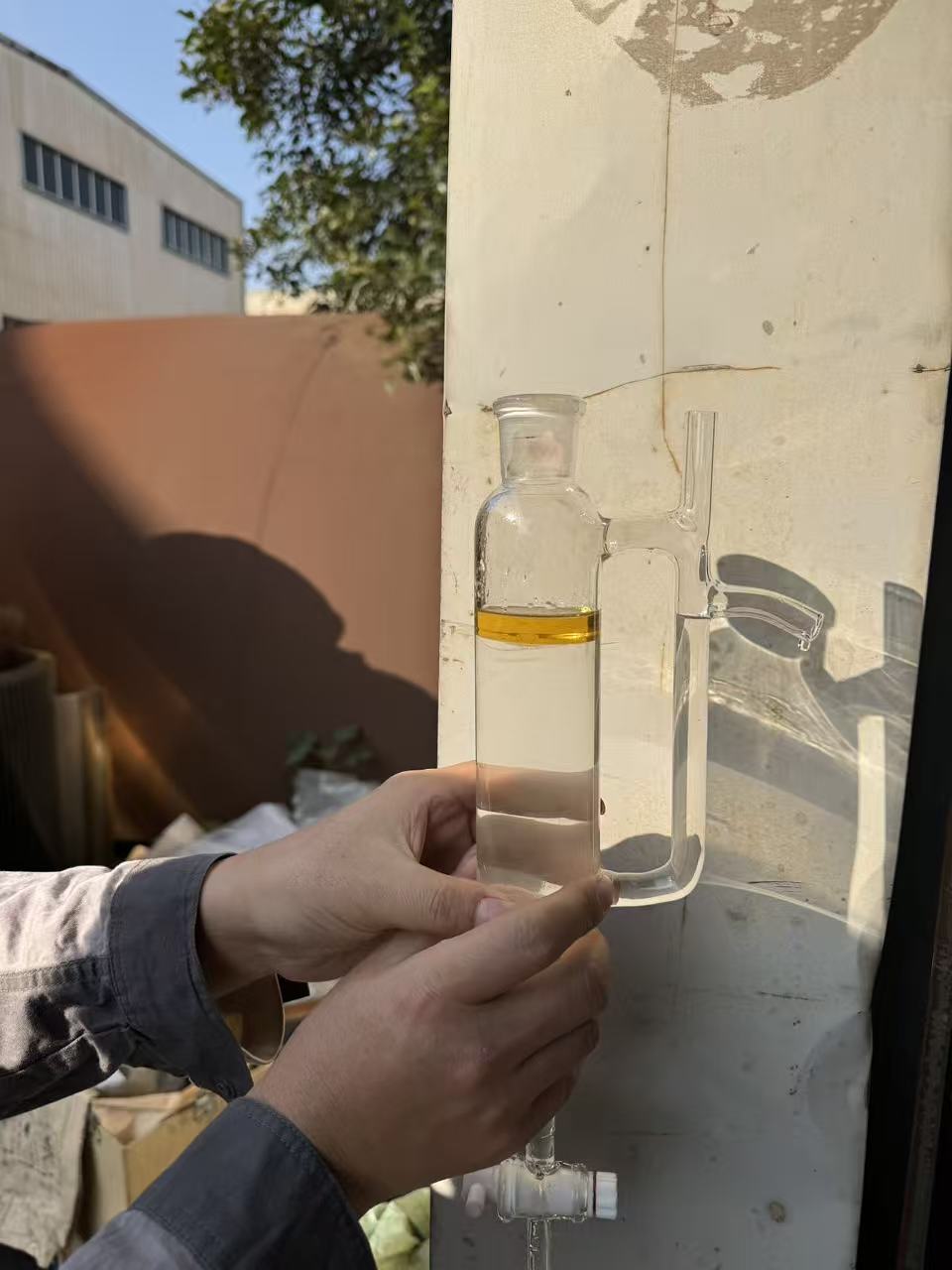
The end of the run: a defined golden-yellow oil band resting on clear hydrosol inside the glass separator.
Why we run a trial before quoting a production line
Thyme is not a forgiving material. Its oil is carried in glands on the leaf and on the fine stems, the valuable fractions are volatile, and the herb arrives with a lot of dust and broken leaf that will do two unpleasant things if you let it: scorch on the heating surface, and stabilise an emulsion in the separator.
So before anyone commits to a vessel size, a steam capacity or a condenser area, we charge a real batch of the customer's own material and watch what happens. A trial run costs a day. A wrong sizing decision costs a season.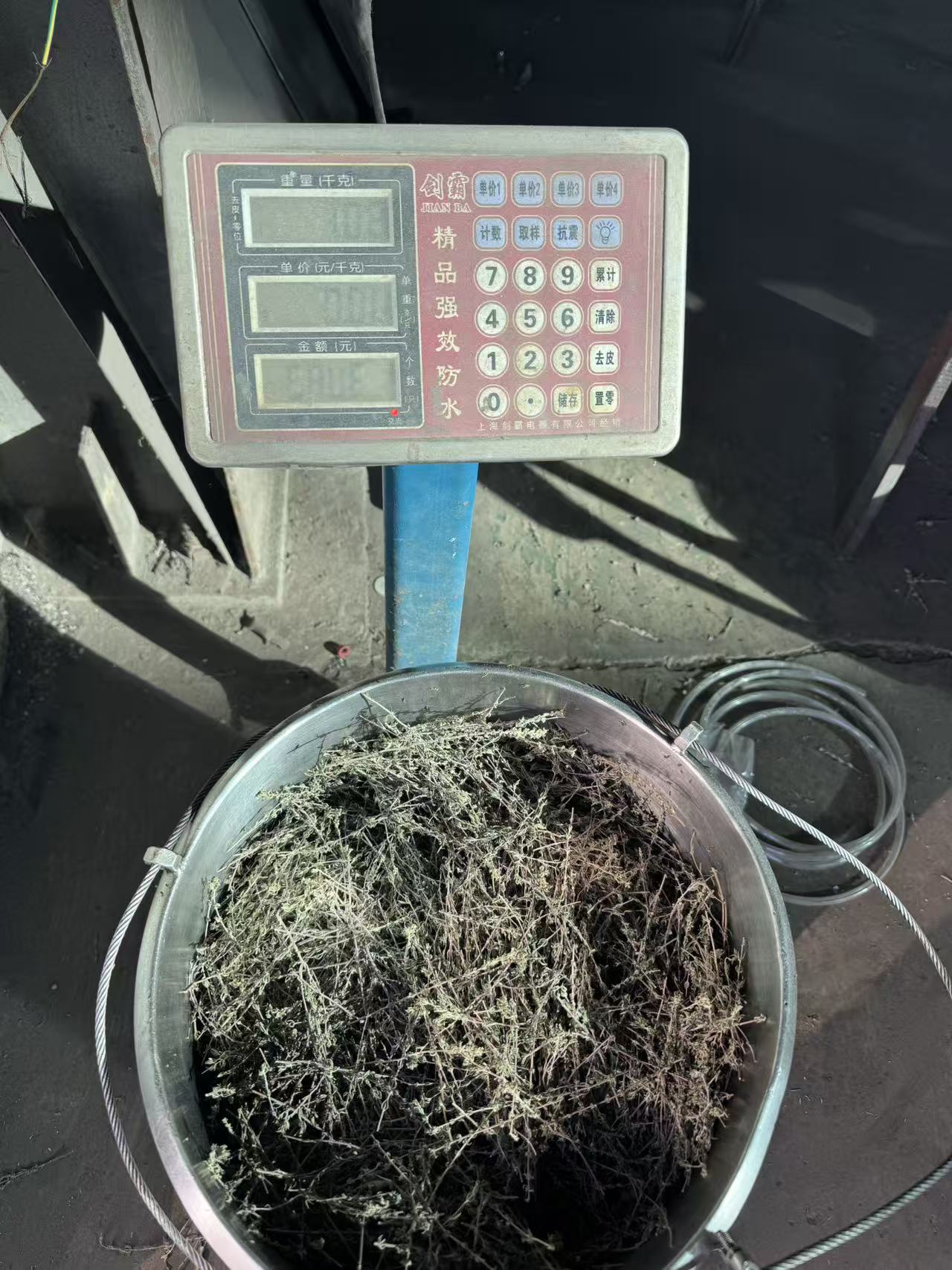
Step one, and the step most often skipped: weighing the dried herb before charging, so that every later figure has a denominator.
Step 1 — Weigh the material, then look at it
The batch arrived as dried, cut thyme — leaf, fine stem and a visible proportion of dust. It was weighed in a stainless bucket on an electronic floor scale before anything else happened, because a yield number without a known input weight is a rumour, not a measurement.
Two observations at this stage matter more than the weight itself:
Fines content. Dust and broken leaf pack down into a dense bed. Steam then takes the path of least resistance around it instead of through it, and you strip the batch unevenly.
Moisture. Bone-dry herb rehydrates slowly and unevenly in the still; very damp herb wastes steam bringing water up to temperature. Either way, the first twenty minutes of the run behave differently.
For a material this dusty, we charge loosely rather than tamping it down, and we keep the steam rate modest at the start so the bed can wet through before it is asked to give up oil.
Step 2 — The set itself
The unit used here is built on a stainless skid: an extraction vessel with a flanged, gasketed top and a motorised head, an insulated vapour line, a condenser, a glass oil–water separator with a PTFE stopcock, a stainless receiver below it, and a PLC touch panel controlling the heating and the run.
The working set: extraction vessel, insulated vapour line, condenser, glass separator and receiver on one frame, with a touch-panel PLC at the right.
Three details of the build are worth pointing out, because they are the ones that get value-engineered out of cheap units:
The separator is glass, and it is in the vapour path where you can see it. A stainless separator is cheaper and stronger, but it hides the only diagnostic you have. With a sight glass you can watch the oil band grow, thin out, or stall — and you know within seconds whether the run is progressing or whether you have flooded the condenser.
The separator has a real drain and a real residence volume. The oil needs quiet time to rise. A separator that is merely a tee in the pipework will carry oil over into the receiver and you will find it later in the hydrosol drum.
Everything wetted is stainless, and the gaskets are silicone or PTFE. Essential oils are solvent-like. They will happily take up plasticiser from a cheap gasket and you will smell it in the finished oil.
Step 3 — Steam, condensate, and the first cloudy drop
Water goes in, the vessel is sealed, heat comes up. The first condensate that reaches the separator is not oil — it is a milky, opalescent stream of hydrosol with oil dispersed through it as micro-droplets. This is normal. It is also the moment where a badly designed separator starts to fail: if the flow is too fast or the path too short, that milk goes straight through and the oil leaves with the water.
Then the dispersion resolves. Droplets coalesce, the lighter phase climbs, and a band forms at the top of the separator.
What the separator actually showed
Sharp interface, no rag layer, no milky band, clear hydrosol below — the three things we check before calling a run successful.
By mid-run the picture was unambiguous:
A defined golden-yellow oil band sitting on top of the aqueous phase, with a flat, stable interface rather than a gradual gradient.
No emulsion ring. No milky collar clinging to the glass at the boundary, which is what you get when fines, heat and turbulence combine.
Clear hydrosol underneath. Slight haze is acceptable; milky is not, because milk in the water is oil you have paid for and are about to pour away.
That is the whole quality argument, and it is a visual one. A clean interface means the steam did not overheat the charge, the condenser is doing its job, the separator is sized right, and the material was clean enough not to emulsify. You do not need a lab to read it. You need a sight glass and the habit of looking at it.
Hydrosol is not waste
Thyme hydrosol — the aromatic water drawn off the bottom of the separator — is a saleable product in its own right: cosmetic base, cosmetic ingredient, household products. On this set it is drawn from the separator drain into a stainless receiver rather than sent to the floor.
If you are costing a thyme project purely on oil, you are leaving revenue in the drain. But it only becomes revenue if the hydrosol is captured cleanly, which brings you back to the same requirement: a separator that separates properly in the first place.
What this means if you are scaling up
A pilot run does not tell you the yield of a production line. What it does tell you is the shape of the problem, and four things carry directly from a 20-litre trial to a two-tonne vessel:
|
Factor |
Why it decides the result |
|
Steam quality |
Wet steam dilutes the condensate and drags fines; superheated steam scorches the herb and pushes the oil toward a burnt, resinous note. The window is narrower than most people expect. |
|
Condensate temperature |
Too cold and the oil turns viscous and films the glass instead of coalescing; too warm and you lose the light, volatile top notes out of the vent. |
|
Separator geometry |
Residence time and a quiet surface. Scale the separator with the steam rate, not with the vessel. |
|
Fines and bed packing |
Channelling strips part of the bed and leaves the rest untouched. Loose charging and a controlled ramp fix most of it. |
Frequently asked
How do you know when a thyme run is finished?
You watch the oil band. While it is still growing, steam is still doing work. When the band stops rising and the condensate coming off has gone flat and watery, the recoverable oil is out. Time alone is a poor indicator, because it depends on charge size, comminution and steam rate.
Can the same unit run other herbs?
Yes — lavender, rosemary, oregano, peppermint, citrus peel with an adapted setup. What changes is the steam rate, the run length and, critically, the cleaning between batches. Residual oil oxidises, turns sticky and carries taste into the next material.
Do we need the glass separator, or can we use stainless?
For a pilot or small production unit, insist on glass. It is the only way to see what is happening in real time. On large lines the separator becomes a stainless decanter and you rely on instrumentation — but by then you should already know, from trials, what the numbers should look like.
Testing your own material
Send us a sample of your herb — dried thyme, oregano, rosemary, lavender, whatever you are working with — and we will run it on a pilot set and send you the photographs, the separation behaviour and a sizing recommendation for the production line. No obligation, and no yield figure invented on a quotation sheet.
Shanghai Ruiyuan Machinery — distillation and extraction equipment, built and tested before it ships.

Shanghai Ruiyuan Machinery Co., Ltd. is a high-tech enterprise specializing in complete production line projects and laboratory equipment for the food, dairy, beverage, biotechnology, chemical, and pharmaceutical industries.
 EN