Patchouli Oil Extraction Equipment: Direct Steam Distillation at Low Pressure
Patchouli (Pogostemon cablin) is grown mainly for its valuable essential oil, distilled from the leaves and tender twigs of the plant. The oil is dominated by heavy sesquiterpenes — high boiling point, low volatility — so the steam has to carry them out slowly, over a long distillation window.
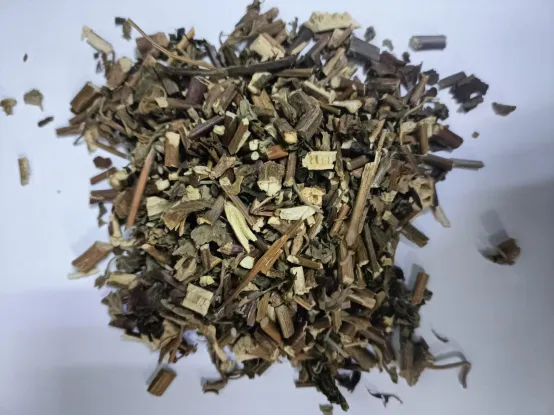
Dried patchouli herb — leaves and tender twigs. Hard mature stems carry almost no oil and are removed before loading.
Public technical literature on patchouli is consistent on four points:
A Chinese study on time-segmented patchouli distillation makes the same point at finer resolution. Measured over the intervals 0–10, 10–30, 30–60 and 60–360 minutes, oil extraction rates were 0.14%, 0.18%, 0.20% and 0.57% respectively.
The first hour is a warm-up. The real output comes afterwards.
The practical conclusion: you cannot win patchouli yield by firing harder at the start. If steam is spent in the first hour, the remaining five to seven hours run steam-starved, the tail drags, and total recovery drops. What patchouli needs is low pressure, steady flow, and long, stable steam supply.
Steam distillation follows one of two routes:
For a long, high-volume run such as patchouli, direct steam brings two decisive advantages:
First, controllable heat input. When steam is generated inside the still, output depends on heating power and water level — change the bed load and the steam rate changes with it. Externally generated steam decouples generation from distillation: steam pressure and flow rate can be set independently, so the 6–8 hour recovery curve stays repeatable batch after batch.
Second, no scorching and no soaking. Material held in water under heat for eight hours can gelatinise and cake, and some water-soluble fractions and esters change under prolonged thermal load. With direct steam, the bed meets steam only — and the spent herb discharges drier.
Run direct steam at high pressure and three problems appear:
Low-pressure steam does the opposite. Lower pressure and a stable flow rate make steam permeate the bed rather than blast through it. The underlying principle of steam distillation is that steam co-carries volatile compounds whose boiling points lie far above that of water; what governs extraction is the degree of contact between steam and material, and the contact time — not how high the pressure is.
For patchouli, low-pressure direct steam maps exactly onto the oil's recovery profile: gentle removal of light fractions early, sustained extraction of heavy sesquiterpenes later, a flatter curve, higher recovery, and a fuller oil that does not smell flat.
|
Process point |
Reference data |
|
Material preparation |
Leaves plus tender twigs, dried to 15–20% moisture, dry-to-fresh ratio about 1:5; hard mature stems contain almost no oil and should be removed |
|
Distillation time |
6–8 hours; recovery rises with time and peaks between 6 and 8 hours |
|
Oil recovery |
2.0–2.5%; one tonne of air-dried herb yields approximately 20–25 kg of oil |
|
Quality marker |
Patchouli alcohol reaches optimum level at about 4 hours of distillation; the widely referenced specification range is 25–30% |
|
Post-distillation |
Separate residual water first, then dry with anhydrous sodium sulphate (about 40 g/L), filter, and store sealed and protected from light |
A Ruiyuan essential oil extraction set in the direct-steam configuration typically comprises the following units:
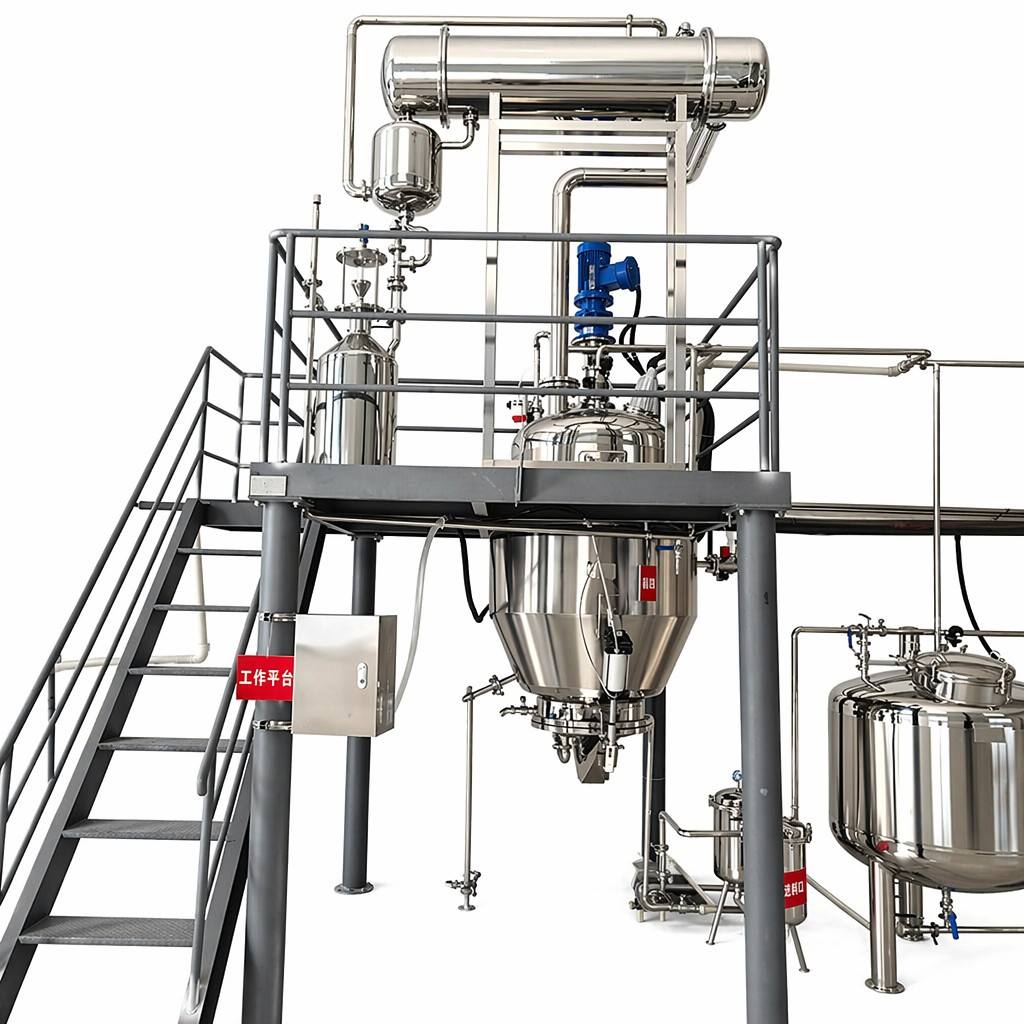
1. Distillation vessel
Vertical sealed stainless steel vessel with an internal perforated plate that separates the material bed from the steam path, so the bed never sits in liquid. Quick-open manway and explosion-proof sight glass for loading, residue discharge and bed inspection.
2. Steam generation and pressure regulation unit
Produces low-pressure saturated steam outside the vessel and distributes it evenly into the bed from the bottom. Adjustable steam pressure and flow are the single most important control point for flattening the recovery curve.
3. High-efficiency condensing system
Double-pass shell-and-tube condenser with ample heat-exchange area for rapid condensation with no vapour escape. Circulating cooling water tank — no continuous mains water supply required.
4. Automatic oil–water separator
Visual sight-glass column separates oil from distillate by density difference, with independent oil and water drain valves. Continuous separation, minimal standing time, low oil loss.
5. PLC control system
Accurate temperature control with over-temperature and low-water protection. Process parameters are loggable, which makes it straightforward to compare different raw materials and batches.
6. Sanitary piping and frame
Fully sealed sanitary pipework with no leakage and no aroma escape. Single-piece frame; castors optional.
|
Item |
Configuration |
|
Model |
[to be filled] |
|
Capacity range |
From 10 L pilot units up to industrial scale, sized to throughput |
|
Distillation method |
Direct steam — generated externally and injected into the material bed |
|
Steam |
Low-pressure saturated steam; pressure set to bed density and target recovery curve |
|
Heating |
Jacketed electric or steam heating, dual option |
|
Condensing |
Double-pass shell-and-tube condenser plus circulating water tank |
|
Separation |
Automatic oil–water separator with sight glass and independent drains |
|
Control |
PLC temperature control, over-temperature and low-water protection |
|
Material |
SUS304 stainless steel; mirror-polished product-contact surfaces |
|
Options |
Reflux, vacuum, circulating water supply, castors |
Repeatable yield. Externally supplied, regulated steam removes the batch-to-batch variation caused by changing bed loads, so the 6–8 hour recovery curve holds steady.
Aroma integrity. Low-temperature extraction throughout, with no dry roasting of the material. Sesquiterpene and ester losses are minimised, and the heavy tail fraction is fully recovered — a fuller oil with no flat note.
No tail drag. Low-pressure constant-flow steam is designed specifically for hours two through eight, avoiding the loss of output that follows a steam-hungry first hour.
Simple operation. PLC control with protective interlocks. Operators are productive after short training, with no need for a specialist to watch the fire.
One plant, many crops. The same set handles rose, lavender, rosemary, lemongrass, litsea cubeba, citrus peel, agarwood and sandalwood — floral, herb, wood and peel materials alike — with easy cleaning between changeovers and no carry-over of aroma.
The biggest risk in an essential oil project is buying large-scale equipment before the process is proven. Our delivery path removes it:
Does patchouli really need 6–8 hours?
Yes. The oil is dominated by heavy sesquiterpenes. Published recovery data peaks between 6 and 8 hours, and patchouli alcohol content only reaches its optimum around the fourth hour. Cutting the run short sacrifices exactly the fraction that carries the value. The lever you can pull is steam efficiency — the right pressure and flow rate to raise output within the same window.
Will direct steam blow the bed apart and clog the condenser?
That is precisely why low pressure is used. At low pressure and moderate velocity, steam permeates the bed instead of striking it. Combined with the perforated plate and an appropriate bed density, the bed stays stable and fines stay in the vessel.
How strict are the moisture requirements?
We recommend drying to 15–20% moisture (a dry-to-fresh weight ratio of roughly 1:5). Wetter material consumes steam heat and lengthens the run; hard mature stems contain very little oil and should be removed before loading.
The oil comes out cloudy — what should I do?
Separate the residual water in the oil–water separator, then dry with anhydrous sodium sulphate (about 40 g/L) and filter to obtain a clear oil. Store it dark, sealed, in a nearly full container.
Shanghai Ruiyuan Machinery Co., Ltd. specialises in distillation and extraction technology. Our product range covers essential oil extraction plants, extraction / concentration / purification / separation equipment, evaporation and crystallisation systems, fermentation equipment, sterilisation lines, spray dryers and pilot-scale food and beverage production lines. We serve university laboratories, aromatic plant estates, flavour and fragrance houses, and herbal extraction manufacturers.
Shanghai Ruiyuan Machinery Co., Ltd.
Address: No. 168 Qingling Road, Fengxian District, Shanghai, China
Contact: Mr. Zhang
Tel: +86 136 0188 4162
Email: [email protected]
Website: www.ruiyuanextraction.com

Shanghai Ruiyuan Machinery Co., Ltd. is a high-tech enterprise specializing in complete production line projects and laboratory equipment for the food, dairy, beverage, biotechnology, chemical, and pharmaceutical industries.
 EN